
Forecourt Signage That Works From Road To Pump
A forecourt site has to do several jobs at once. Drivers must spot the site from a distance, read fuel and convenience offers quickly, then move through the property without confusion. That means the signage mix has to start with visibility on the main road and carry through to the canopy, price board, shopfront and exit points.
For most fuel forecourts, the first question is not what looks good, but what can be read in two seconds by a motorist doing 60 to 100 km/h. We usually begin with sightlines, traffic approach angles, stopping distances and the position of nearby intersections, then size the pylon, canopy panels and directional signs around those facts. In Johannesburg, Pretoria and along the N3 and N1 corridors, dust, winter dryness and summer storms all affect finish choices and maintenance cycles.
Where sites include a convenience store, car wash, quick-service food outlet or truck access, the signage plan has to keep each function clear without clutter. A strong forecourt system normally balances brand presence, pricing visibility and safe customer movement through the property.
Typical Equipment Set For A Busy Fuel Site
A forecourt package is usually a combination of externally lit and internally lit elements, plus wayfinding and compliance signage. We specify the set according to the site size, road exposure and the landlord or municipal controls in place.
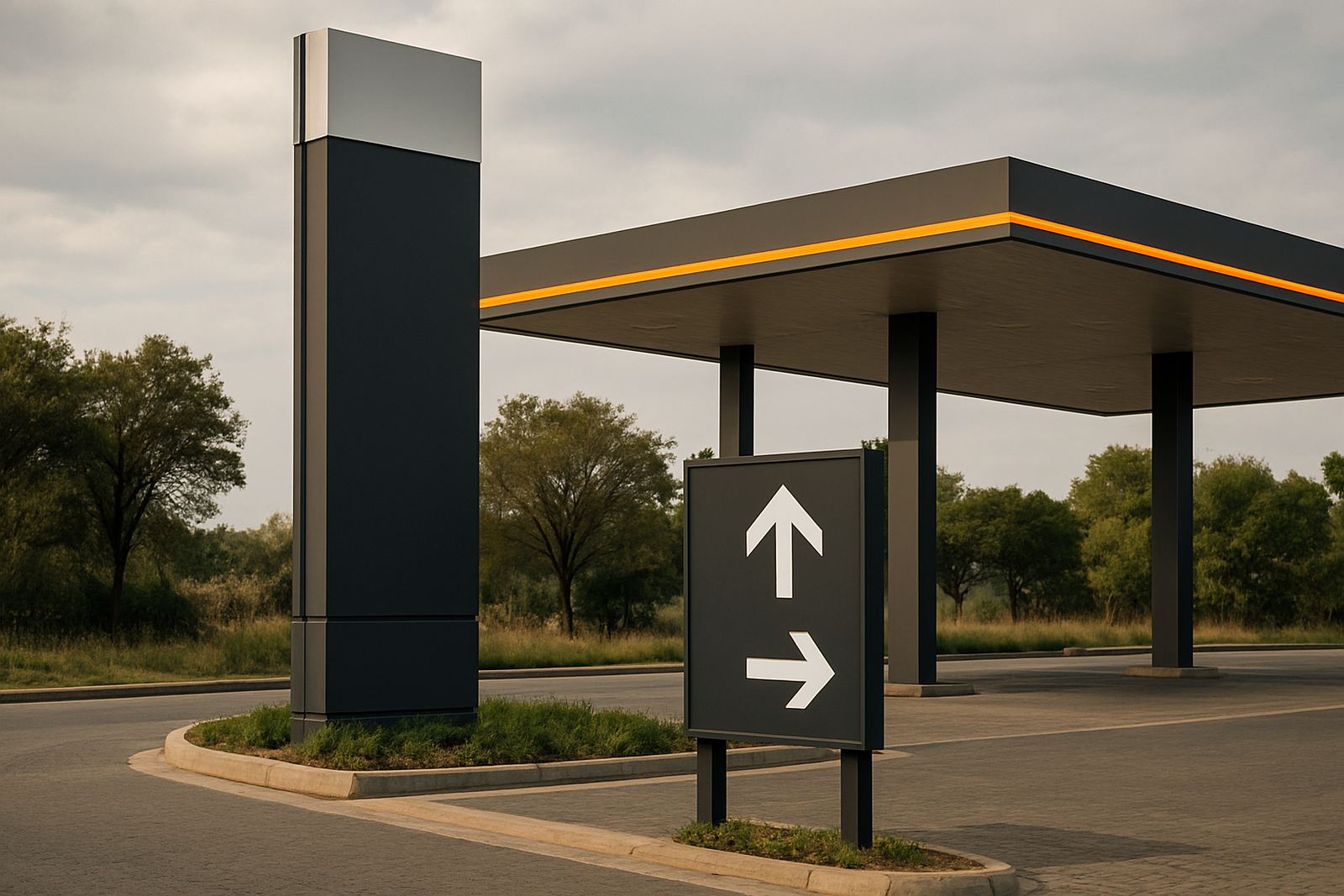
- Main roadside pylon sign for fuel branding and price visibility
- Canopy fascia and column wraps for repeated brand exposure
- Directional arrows, entry and exit signs, and pedestrian guidance boards
- Shopfront lettering and window graphics for convenience retail
- Safety, no smoking, speed control and parking information signs
- Optional LED price panels or video screens where permitted
Aluminium, Perspex, fabricated steel and durable vinyl are common choices, but the final material depends on whether the site is inland, coastal or exposed to heavy grime. In Durban and other coastal areas, corrosion resistance matters from day one. In Gauteng, UV exposure and load shedding mean illuminated signs need careful electrical planning, battery backup where needed and easy access for maintenance.
How We Plan The Layout Before Fabrication Starts
Good forecourt planning starts on site, not in a workshop. We look at vehicle turning circles, forecourt islands, queue lengths, canopy height, sightlines from the road and the position of underground services. A pylon placed too close to a boundary wall can lose visibility. A directional sign placed too low can be clipped by delivery vehicles. A shopfront sign sized only for pedestrian viewing often disappears once the site is busy.
Our planning work normally includes site surveys, design development, material specification and structural coordination. For larger sites or multi-tenant forecourts, we also consider municipal approval timing, landlord restrictions and structural loads for high wind zones. It is cheaper to correct the drawings early than to move steel, redo cabling or reprint panels after fabrication. Small mis-measurements become expensive very fast on a busy site.
We also plan access for future maintenance. If a canopy sign needs to be serviced, there must be safe access for technicians, proper isolation points and a clear method to replace printed faces or LEDs without shutting the whole forecourt down.
Common Mistakes On Forecourt Projects
Many forecourt projects run into trouble because the signage is treated as an afterthought. That usually shows up in one of a few ways.
- Price boards that are too small to read from the street
- Directional signs that conflict with painted traffic arrows
- Canopy lettering that is visible only from one approach
- Materials that fade too quickly under strong sun or coastal humidity
- Illumination that is bright on paper but uneven at night
- No allowance for maintenance access, cable routes or safe lift points
Another common issue is trying to save money on the structural side and then losing it in rework. A pylon or LED screen needs proper engineering and coordination from the start. If the base plate, footing or cable route is wrong, the project can stall while the forecourt is already open for trade. That creates real pressure on operations and customer flow.
Budget Ranges For Gauteng And Regional Sites
Budget depends on site size, number of elements, lighting method and whether the project includes structural steel, approvals and installation. As a practical guide, a modest forecourt refresh with directional signs, canopy fascia graphics and shopfront lettering can start from around R85,000 to R180,000.
A mid-range forecourt package with a new pylon, canopy branding, printed vinyl, safety signage and coordinated installation often sits between R220,000 and R650,000. Larger roadside sites with fabricated 3D lettering, engineered pylons, multiple illuminated faces and LED screen integration can move from R750,000 upwards, especially where civil works or special approvals are required.
For municipalities, developers and national operators, we break costs into measurable parts so the brief stays clear. That normally includes design development, material specification, fabrication management, installation management and project handover. It helps clients compare options properly instead of only looking at one lump sum. The cheapest quote is rarely the one that performs best after 18 months of sun, rain and traffic grime.
What A Forecourt Client Usually Needs From Us
Most clients come to us when they need a site that opens on time, presents well from the road and stays safe and legible once traffic starts moving. In practice that means one team handling the signage strategy, the technical drawings, the fabrication schedule and the rigging plan.
Operating from Modderfontein, Johannesburg, the team supports sites in Sandton, Midrand, Randburg, Germiston, Pretoria, Centurion, Durban and further afield in Africa. Project engineering, design and visualisation, fabrication supervision and site rigging coordination are handled as part of one process from brief to handover. On forecourts, that matters because delays affect opening dates and trading.
If the site has to be phased, we can sequence the work so the canopy, pylon and directional elements go in first, with secondary graphics and maintenance items added as access becomes available. That keeps the forecourt usable while the project moves forward. It also makes it easier to work around weather, delivery windows and municipal inspections.