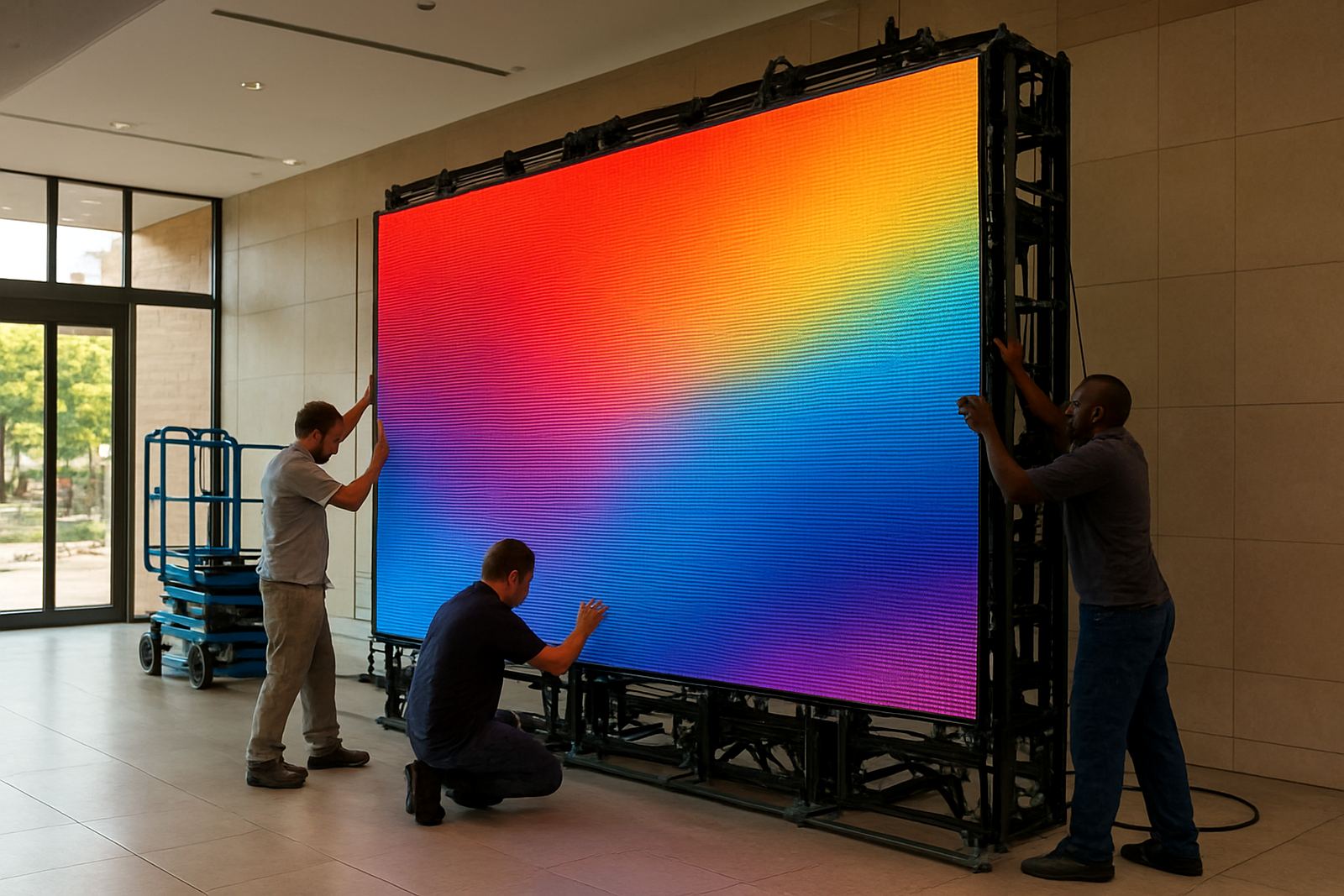
Fine-pitch indoor LED walls for close viewing
Indoor LED walls are modular display systems built from individual cabinets that lock together to form one large screen. For interior use, the focus is on fine pixel pitch, even brightness and clean image quality at short viewing distances. That makes them suitable for reception areas, boardrooms, conference centres, control rooms and retail launch spaces where people stand or sit close to the screen.
Typical fine-pitch indoor options start at 0.9 mm and run through 1.2 mm, 1.5 mm, 1.8 mm, 2.5 mm and 3.0 mm depending on the viewing distance and content type. Smaller pitches show more detail, while larger pitches can still work well in bigger foyers or auditoriums. We match the pitch to the room, the viewing distance and the content so the screen does not look grainy from the front row.
Indoor walls are usually brighter than a TV, but they are not meant for direct sun or outdoor exposure. In Johannesburg buildings with strong glass fronts, we also check glare, reflections and ambient light before specifying the final layout.
Panel sizes, shapes and screen formats
Most indoor LED walls are built from standard cabinets, which makes them flexible for custom sizes and unusual shapes. A wall can be a simple rectangle, or it can wrap around a curved wall, sit above a counter, or form a tall vertical feature for a launch area. The final size is set by cabinet module size, the required resolution and the available wall structure.
- Common cabinet sizes are around 500 mm x 500 mm or 500 mm x 1000 mm
- Popular screen ratios include 16:9, 4:3 and custom widescreen formats
- Pixel pitches commonly specified indoors: 0.9 mm to 3.0 mm
- Brightness is generally specified between 600 and 1200 nits for indoor use
- Refresh rates from 3840 Hz and above are preferred for clean camera capture
If the screen needs to fit a specific wall opening or existing joinery, we can work back from the opening size and set the cabinet layout to suit. That helps when the screen has to align with cladding, reception finishes or a feature frame.
Where indoor LED walls work best
Indoor LED walls are used where people need a strong visual focal point and the content changes often. They are practical for live data, presentations, welcome messages, event branding and control room monitoring. In Gauteng offices and venues, they are often used in reception foyers where the screen carries the first impression before visitors move into meeting spaces.
They also suit environments where standard screens are too small or where multiple screens would look untidy. In a control room, for example, a single wall can show camera feeds, site status and alerts without breaking the viewing field into small separate panels. In retail or hospitality, the same wall can switch between advertising, wayfinding and live event graphics through the day.
- Corporate foyers and reception areas
- Control rooms and monitoring centres
- Conference halls and training venues
- Retail launch spaces and showrooms
- Municipal briefing rooms and public information spaces
Installation, power and room requirements
Indoor LED wall installation starts with the structure behind the screen. The wall or frame must carry the dead load of the cabinets, support the mounting system and allow access for servicing. We check wall flatness, access routes and the space needed for power supplies, signal equipment and ventilation. For larger screens, a steel support frame is often the cleanest option, especially where the existing wall is not level or is not built to carry the load.
Power needs depend on screen size and brightness, but a dedicated electrical circuit is usually required. Many projects use single phase or three phase supply depending on the total load. We also consider the building's power stability, especially in areas affected by load-shedding or where backup supply is already part of the site. A UPS or generator interface may be needed for controllers and signal gear, but the exact setup depends on the room and uptime requirement.
Heat build-up and airflow matter too. Indoor LED walls do not need gas, but they do need ventilation space behind the cabinets and clear access for cable runs. In coastal areas like Durban, we also allow for humidity control and anti-corrosion choices on fixings and frames. In dusty or high-traffic buildings, the access plan matters because service panels must be reachable without disturbing the whole wall.
Maintenance, servicing and day-to-day care
A well-specified indoor LED wall should be easy to keep in service. Routine care is mostly about cleaning, checking ventilation and making sure the content system is running properly. The face of the wall should be cleaned with approved dry methods and soft tools, not with harsh liquid cleaners that can leave residue or damage the modules.
We recommend a maintenance plan that includes scheduled inspections of power supplies, receiving cards, signal paths and cabinet alignment. If the wall is in a venue that runs every day, it helps to keep a few spare modules on site. That shortens downtime if a panel fails or if a cabinet is damaged during a move or event changeover.
- Keep vents clear and do not block rear access
- Use stable content playback equipment and verified signal cables
- Check brightness settings for the time of day and room lighting
- Inspect for pixel faults, colour shift and loose fixings regularly
- Plan for controlled shutdowns during power interruptions
What to check before you order
Before placing an order, it helps to define the room, the viewing distance and the content type. A screen used for close-up presentations needs a finer pitch than a wall viewed from across a foyer. You should also confirm the available width and height, the wall structure, the power supply and whether the site will need a steel frame or a custom enclosure.
It is also worth checking who is responsible for approvals and handover. In commercial buildings or municipal sites, access to the wall may be controlled, and the installation schedule has to fit other trades. If the project is in a live environment, we plan for night work or phased installation where required. We also confirm signal sources, content format, control room integration and whether the screen must connect to existing building systems.
- Viewing distance and audience position
- Screen size, aspect ratio and resolution target
- Brightness requirement and ambient light levels
- Wall strength, support frame and rear access space
- Power supply, backup arrangement and cable routes
- Content source, control system and servicing access
Support from specification to handover
Indoor LED wall projects for brands, developers and municipalities are delivered from Modderfontein, Johannesburg across Gauteng and further afield. The team handles signage strategy, site surveys, material specification, structural coordination, installation management and project handover, so the screen is properly planned before fabrication and rigging begin. Whether it is a foyer wall in Sandton, a control room in Pretoria or a launch space in Durban, the same early checks still apply.
We prepare the details that help contractors and building teams move without confusion: dimensions, access needs, power expectations, support structure and servicing method. That makes the project easier to manage and reduces surprises on site. If you need a screen that has to work from day one and still make sense when someone has to service it later, the specification has to be done properly.
Key facts
| Use case | Indoor foyers, control rooms, conference halls, launch spaces and branded interiors |
|---|---|
| Pixel pitch | 0.9 mm to 3.0 mm typical, matched to viewing distance |
| Brightness | About 600 to 1200 nits for indoor conditions |
| Cabinet format | Modular panels, commonly 500 x 500 mm or 500 x 1000 mm |
| Refresh rate | 3840 Hz or higher for smooth video and camera use |
| Service access | Front service or rear service, depending on the build and site layout |