What Directional Wayfinding Does On A Busy Site
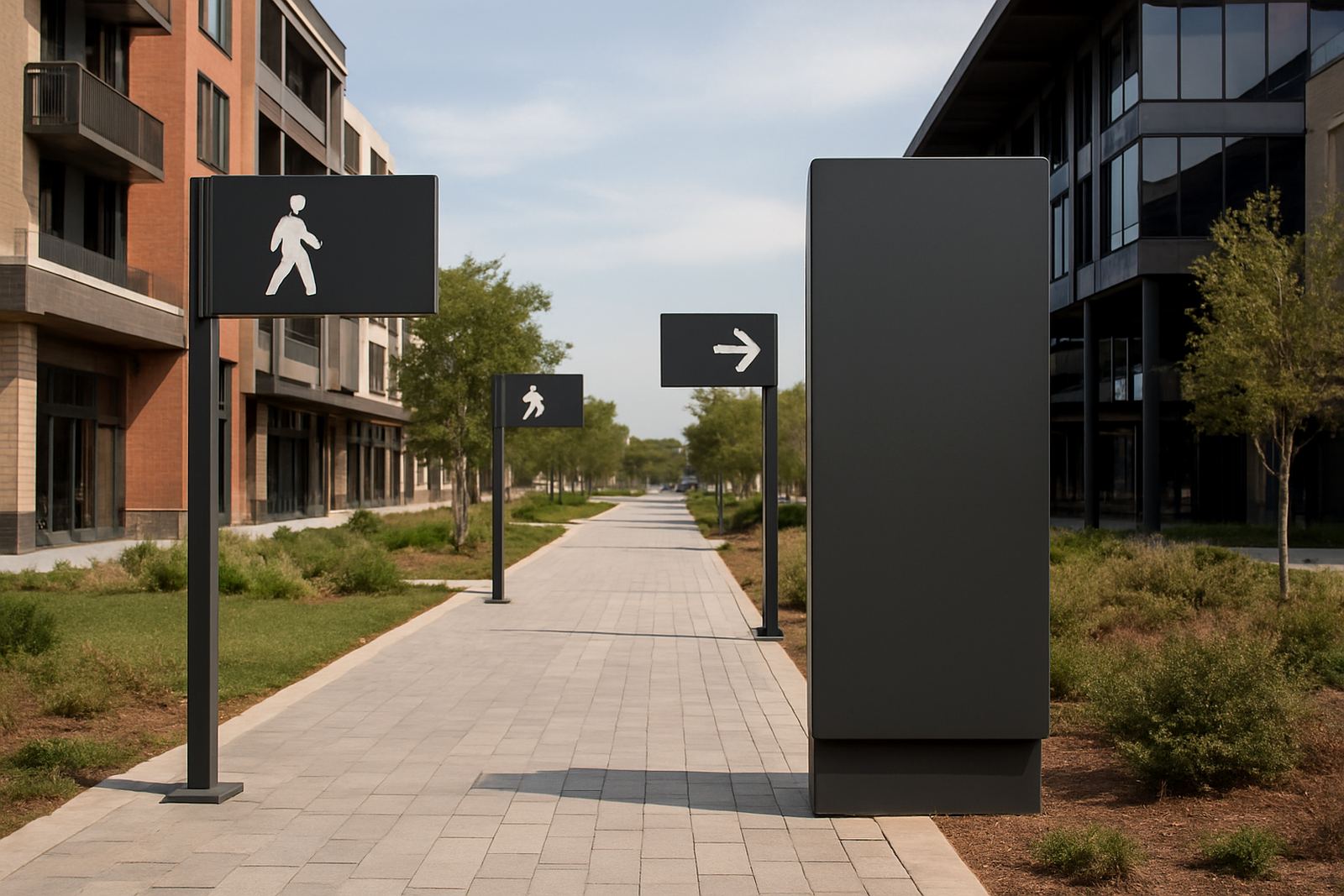
Directional wayfinding is the system of signs, posts, markers and route cues that helps people get where they need to go quickly and safely. It covers vehicle movement, pedestrian routes, visitor parking, staff access, deliveries, emergency access and building entries. On larger sites, it often includes a mix of freestanding signs, wall mounted panels, pavement markers and overhead or gateway signs so the route reads clearly from the first turn to the final destination.
In Modderfontein, Sandton, Midrand and other fast moving parts of Johannesburg, a site can have multiple access points, controlled gates and changes in level. Good wayfinding reduces missed turns, illegal stopping and congestion at entrances. It also supports compliance where municipal rules, fire access and traffic flow need to be considered from the start. A sign that looks neat but cannot be read at speed is not useful, so spacing, contrast, mounting height and sight lines matter just as much as the message.
Common Sizes, Formats And Materials
Wayfinding systems are rarely one-size-fits-all. A retail park in Randburg needs different sign sizes to a logistics yard in Germiston or a municipality depot in Pretoria. We specify each component to suit viewing distance, speed of travel and the size of the site. Smaller pedestrian signs may be 300 x 600 mm or 450 x 600 mm, while driver-facing panels often start at 600 x 900 mm and can grow well beyond that for higher speed approach roads or large plots.
Materials are selected for weather, cost and upkeep. Aluminium composite panel is common for flat panels, with powder coated aluminium frames for posts and support arms. Routered Perspex can be used for raised legends or highlighted zones, while brass or other metal trims may be used where a more formal finish is wanted. Reflective vinyl is useful for low-light visibility, and in some locations we pair signs with integrated LED illumination for night-time clarity. For coastal work, particularly where humidity is high, fixings and finishes are specified to reduce corrosion and staining.
For multi-tenant sites and phased developments, modular panels make it easier to update unit names, arrows and tenant lists without replacing the entire system. That saves time and money when occupiers change, which they often do. On larger projects the structure can include ground-fixed posts, wall brackets, cantilever arms, ceiling hangers or monument style pylons depending on the route and the available space.
Where Directional Wayfinding Works Best
This product suits places where visitors do not know the site layout and where movement needs to be controlled or directed. That includes business parks, factories, estates, hospitals, schools, mixed use developments, distribution centres, public facilities, parking decks and municipal sites. It is also useful for large temporary events, construction access routes and new developments where the final circulation pattern must be signposted before the site is fully complete.
For developers, wayfinding helps a site feel organised from day one and can reduce calls to security or reception asking for directions. For municipalities, it can improve public access to clinics, libraries, depots, customer care centres and parking areas. For industrial sites, it helps trucks, staff vehicles and walk-in visitors follow separate paths without crossing where they should not. The system can be introduced in phases, so the most critical routes are signposted first and later additions are matched to the same visual language.
We also plan for South African conditions. Load-shedding, poor ambient lighting, dust, wind and summer storms can all affect legibility and mounting. In outdoor areas, we check whether the sign should be illuminated, retroreflective or simply positioned where headlights and natural light will do the job. Where there is a lot of vehicle movement, impact protection and safe edge treatment are worth including from the start.
Survey, Approval And Layout Before Fabrication
A wayfinding project starts with a site survey. We check the access points, travel speeds, turning circles, sight lines, barriers, existing signs and lighting conditions. We also look at the route sequence from the point of entry to the final destination, because a sign placed too early or too late can make the whole system fail. On many sites the first issue is not the sign itself but the position of trees, walls, guardhouses or kerbs that block the line of sight.
After the survey, we develop the sign schedule, material notes and location plan. Where needed, we support approvals for municipal or estate controlled sites, and we coordinate with engineers or architects if structures need to be checked. If the site includes roads or public access, we make sure the sign layout aligns with the movement plan and any required setback or clearance rules. Good planning saves rework later, and it stops a simple directional sign from becoming a snag item.
Clients usually provide a list of destinations, unit numbers or department names, but we can also help clean up inconsistent wording. For example, if one part of the site says visitor parking and another says guests, we standardise it so the whole system reads the same. That may sound small, yet it makes a big difference when people are moving quickly and maybe under pressure.
Installation, Power Needs And Structural Support
Installation depends on the sign type. Wall signs and internal direction panels may need only mechanical fixing, while freestanding posts, cantilever arms and large monument units need proper foundations and structural coordination. For outdoor sites, we consider wind loading, ground conditions and vehicle strike risk. A sign that looks fine in the workshop can fail quickly if the base is under-sized or the post is set too shallow.
If the wayfinding includes illumination, we plan the electrical supply early. LED light boxes and illuminated arrow panels generally need a safe power feed, isolation point and weather-protected wiring route. On sites with unreliable supply or load-shedding, we can specify low energy LED options, battery backup where it is practical, or integration with the site’s existing generator or backup circuits. For very large developments, timing, access for lifts or cranes, and out of hours work may need to be built into the programme. That keeps the site open and avoids disruption to tenants and visitors.
Installation is managed so that signs are level, aligned and readable from the correct approach angle. Where a route changes direction, we often stage the sequence so a driver can read the next instruction before reaching the turn. That sounds obvious, but it is where many sites go wrong and end up with late braking or wrong turns.
Care, Maintenance And Key Checks Before Ordering
Directional wayfinding works best when it is kept clean and current. Dust, overspray, faded vinyl and damage from vehicles can all reduce performance. Regular washing with mild soap and water is usually enough for most panels, while illuminated signs should be checked for failed modules, loose fittings and water ingress. In industrial areas, a quick inspection after heavy wind or vehicle contact can prevent a bigger problem later.
If the site changes often, build maintenance into the original plan. Modular face panels, replaceable inserts and standardised mounting hardware make updates faster and cheaper. For sites near the coast, stainless or coated fixings are worth the extra spend because rust marks on otherwise good signage can make the whole entrance look neglected. A little planned servicing goes a long way, and it keeps the system working as intended.
Before ordering, check the wording, route order, sign sizes, mounting positions and whether any panel needs light or reflective finish. Make sure the final list of destinations is signed off by the people who actually use the site, not only by the people who drew it. It is also wise to confirm the opening date, any phased handover and whether the site will still be under construction when the signs are installed. That avoids confusion and keeps the sequence correct from the start.
Key facts
| Typical panel sizes | 300 x 600 mm to 1200 x 2400 mm, with custom sizes available |
|---|---|
| Mounting options | Wall fixed, post mounted, cantilever arm, ceiling hung or monument style |
| Material options | Aluminium composite, aluminium sheet, Perspex, steel frames and metal trims |
| Finish options | Powder coat, printed vinyl, cut vinyl, reflective film or illuminated face |
| Outdoor suitability | Designed for UV exposure, wind, dust and heavy rain when specified correctly |
| Power requirement | None for non-illuminated signs, or standard electrical feed for LED lit units |